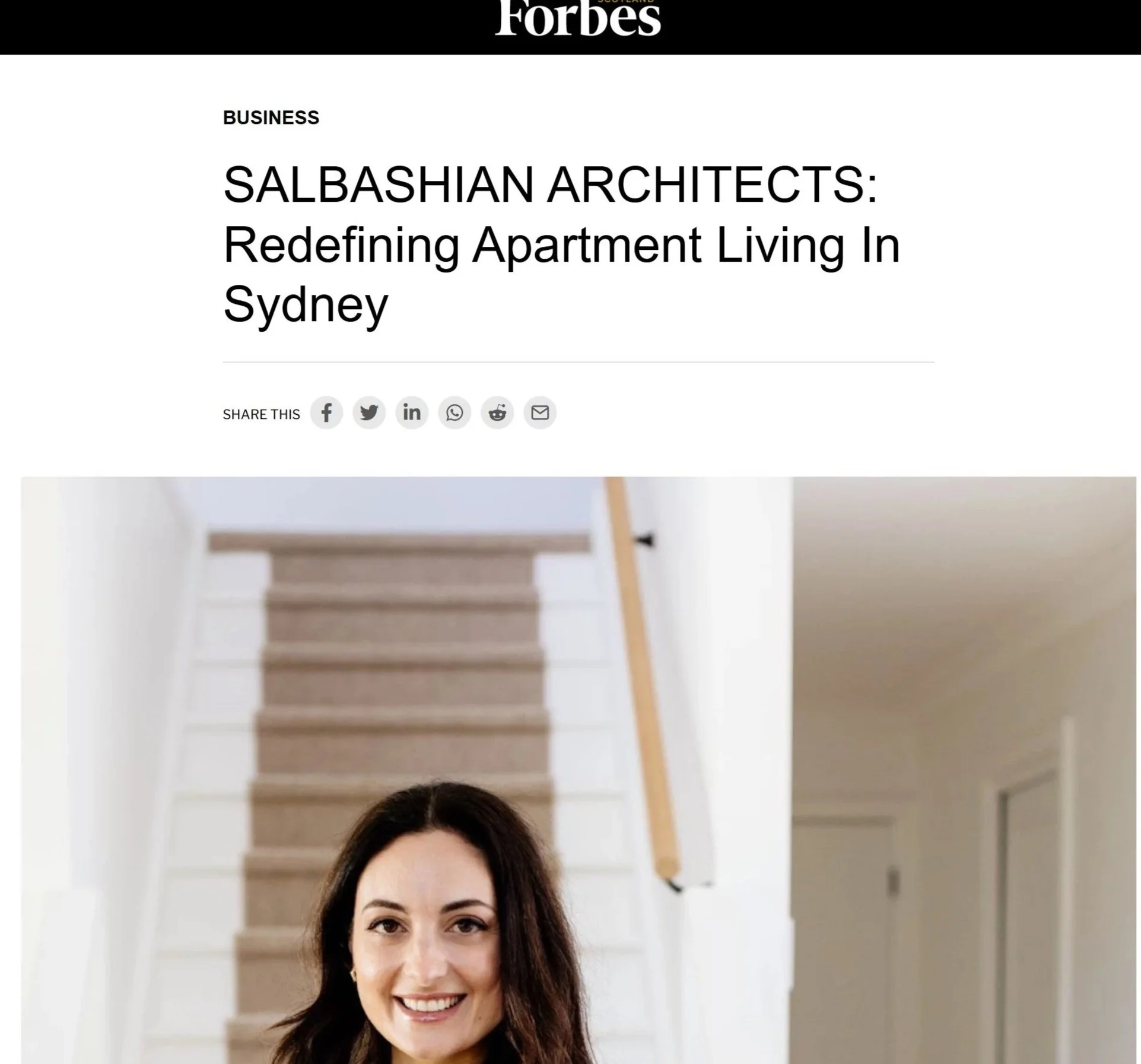
About Linette

Linette Salbashian is a registered NSW Architect and Principal of SALBASHIAN ARCHITECTS.  She has 15 years of experience in Australian residential architecture, having worked on boutique, large-scale, complex and high-end projects, and has seen first-hand what clients are looking for through many years of working in the residential property development industry.

She has had hands-on experience with understanding customer challenges and prototyping ideas to provide solutions as part of her involvement in the design and innovation teams at Mirvac, an award-winning property development company. This included working as an architect on complex residential projects and being an integral part of launching Australia’s first ever underground urban farm. Find out more about the launch here.

Linette is a registered NSW design practitioner in architectural works for Class 2 type of buildings such as apartments and certain types of townhouses.

This registration and title is given to NSW registered architects who have had at least 5-10 years of experience specifically in Class 2 buildings. From July 2021, you require a class 2 design practitioner to provide regulated drawings to authorities for approvals.

  • - Apartment blocks,

    - A single apartment unit,

    - The apartments part of a mixed-use building (such as apartments above retail space)

    - Row of townhouses over common garage or that have a common outdoor space,

    -Two storey townhouse with separate residence on ground floor, and with separate entries.

Linette graduated with a Masters in Architecture from the University of Technology, Sydney, completed studies in entrepreneurship and innovation, and received the UTS BUILD scholarship to travel and conduct research in China.

She has tutored and lectured at the university, she is regularly invited to design reviews in the architecture school, and project reviews in the business school for innovation and entrepreneurship. She is also a mentor to students as part of the UTS Professional Mentoring program. Linette has been featured in media articles such as Forbes and CEO Weekly.


 Mission

SALBASHIAN ARCHITECTS, based on the North Shore of Sydney, is a boutique design studio that has come out of the 2019 global pandemic, a time where many may have lost their connections to others due to lockdowns and travel bans. This pandemic has highlighted the pre-existing human condition of the need for emotional connection between people and place and the desire of having a sense of belonging and intimacy. Many may also have lost the connection to themselves due to sharing the same space with one another most of the day, with less privacy and time to nurture their own selves.

A new type of housing is emerging

Now that we have gone through the pandemic together, issues such as the desire for human connection, more privacy, flexible working, better health, wellness, rest, sustainability, convenience and purpose will become even more important than ever. I believe this is changing the housing industry and will result in a new type of housing to emerge.

SALBASHIAN ARCHITECTS is on a mission to bridge the gap of human isolation to connectedness through architectural design.

The global pandemic has created a permanent mark on the way we live our lives and inhabit our homes. At SALBASHIAN ARCHITECTS, we continue to study how the socio-economic context affects human behaviour and alters the requirements for housing.


Design Values

  • Creating a functional and beautiful home that can reflect your individuality, a home which would become an extension of yourself during big transitions in your life, such as downsizing from your current home, buying your first home, or adding more kids and pets to your family.

  • Providing a contemporary, fresh and on-trend living experience so that you can enjoy with members of the house or entertain family and friends who visit.

  • Creating spaces which incorporate your daily activities and family rituals to match your current lifestyle and future goals, and to reflect on changes occurring in society such as post-pandemic living requirements.

  • Designing for light, air and thermal comfort

  • Maximising storage solutions

  • Incorporating the surrounding context, such as trees, fauna, local street materials, textures, neighbourhood history for a cohesive design concept.

  • Increasing the value of your home to borrow against or sell in the future

  • Creating a legacy home to be passed down to the next generation and kept in your family for future years to come.


Design Tools

Linette uses Design-Thinking processes and has applied this throughout her career in her involvement with various organisations throughout the years. These methodologies stem from training and material used from IDEO, Richard Buchanan (Wicked Problems), David Kelly, Stanford University, the University of Sydney and the University of Technology, Sydney.


The 5-Step Design-Thinking Process:

  1. Research & Expand the Problem - Stakeholder/Customer Interviews & Research Methods Used

  2. Decide on the Best Problem to Focus on - Label the Problem & Pain Point

  3. Come up with Ideas through altering environments, brainstorming techniques tailored to either individuals or groups

  4. Prototype & Test ideas by designing & implementing experiments

  5. Repeat/Pivot - using multiple iterations to test and refine design

    Please click on the arrow below to see the list of tools you can use:

 
  • - 5 Whys

    - A/B split testing

    - Affinity Diagramming

    - Assumption Reversal

    - Autobiographical Diaries

    - Backcasting

    - Body mapping

    - Body Storming

    - Brainwriting 6-3-5

    - Business Model Canvas

    - Business Model experimenttaion

    - Card Sorting

    - Cartographic Mapping

    - Channel Mapping

    - Co-design workshops

    - Competitor analysis

    - Context Mapping

    - Contextual observation

    - Cultural Probes

    - Decision matrices

    - Design by metaphor

    - Design Critique

    - Design Team Cards

    - Design Timescapes

    - Direct Experience storyboards

    - Empathic modelling

    - Empathy Mapping

    - Experience Prototyping

    - Experience Sampling

    - Extreme Characters

    - Focus Groups

    - Forced association

    - Future workshops

    - Group Passing

    - Group Optimisation

    - Hero Stories

    - Heuristic Evaluation

    - How Might We

    - Impact Ripple Canvas

    - Interaction relabeling

    - Interviews

    - Jobs To Be Done

    - KJ Brainstorming

    - Laddering

    - Local Orbits

    - Low fidelity Prototyping

    - Mapping Space

    - Material exploration

    - Mind Mapping WWWWWH

    - Mock-ups

    - Mood Boards

    - Morphological Charts

    - Non Human personas

    - Online ethnography

    - Perceptual Maps

    - Persona Based walkthroughs

    - Personas

    - Pop ups

    - Questionnaires

    - Reframing

    - Research Visualisation

    - Role Playing

    - Scenario based thinking

    - Scenarios

    - Science Fiction prototyping

    - Set the Scene

    - Service Blueprints

    - Sketching

    - Sketchnoting

    - Speculating preferred futures

    - STEP Cards

    - Storyboarding

    - Strategy choice cascade

    - Systems Mapping

    - Thematic Analysis

    - Think Aloud Protocol

    - Trends Lens

    - Usability Testing

    - User Journey Mapping

    - User Profiles

    - Value Proposition Canvas

    - Values Cartouche

    - Video Prototyping

    - What Would X Do?

    - Wireflows

    - Wireframing

    - Worst Possible Idea


Mirvac - Placemaking Innovation in Property

Linette Salbashian was involved in the placemaking project with Mirvac during her role in the innovations team. This included coming up with a design solution and coordinating the events during the launch of the first Australian urban farm located in the carpark of 200 George Street, Sydney. This was a pilot project to test out the effectiveness of adapting under-utilised spaces in our buildings and city, including finding new uses for carparks, especially with the rise of the ride share economy. Read more here.

Mirvac - Research & Product Development

Issues such as housing affordability, sustainability and effects of the pandemic on rental customers were looked at and new ideas and solutions to pressing problems and pain points were presented.

Mirvac - Management & Implementation of Design Competition

Linette was involved in running and implementing a companywide design competition in the Mirvac Sydney headquarters offices during her role in the innovation team. This included creating the competiton brief and setting up environments for creativity and offering consultations and workshops in them during the lead up to the competition.


University of Sydney - Education

Linette regularly teaches design classes such as Design Processes, Design-Thinking, Experience Design, Interactive Design and Digital Revolutions at Sydney University. For more information on each course, click on link: DECO2016: Design Thinking (sydney.edu.au), https://www.sydney.edu.au/units/DESN9002, https://www.sydney.edu.au/units/IDEA9202,

University of Technology & Sydney University - Flood Crisis Relief Community Engagement Pilot

Linette Salbashian was invited to engage and provide critical feedback to a pilot study and experiment collaborated with academics in the Design Lab at the Architecture, Design and Planning Faculty. Her experience in architecture, planning and design-thinking tools allowed her to be an active participant in this study.

The study was based on using AI-supported tools to enhance community engagement for crisis resilience using speculative scenario, personas, to envision the future of community resilience after a major flooding event.

University of Technology, Sydney - Business & Entrepreneurship School Advisory

Linette participated in critiquing MBA Executive and MBA Entrepreneurship students on multiple occasions while they were working with real life businesses.

University of Technology, Sydney - Human-Centred Design Book Published

During her Master’s course in Design, Linette and her peers conducted research on new products and services to tackle issues in homelessness and was published in the book ‘Practicing: Strategizing Engaging Sensemaking Doing Pitching Reflecting’ in 2012.